 Los
Llanos – South American Safari
Los
Llanos – South American Safari
Plains, Rains and Caymans
Covering
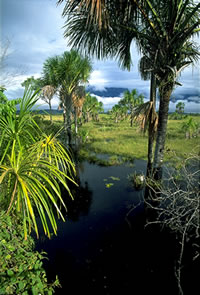
much of the western third of Venezuela, Los Llanos (the plains)
stretch across the horizon in a land of extremes, epitomizing
a wildlife lover's dream. The seemingly endless savannahs, marshes
and woodlands and their related wildlife are directly tied to
annual cycles of rain and dry seasons. The prolonged, heavy rains
that fall from mid-May to mid-November are starkly contrasted
to the dry season during the rest of the year, when not so much
as a drop falls for weeks.
This
unique climatic situation has provided some equally unique adventure
and ecotourism opportunities. Imagine riding herd with Venezuelan
cowboys on this vast frontier; or navigating the 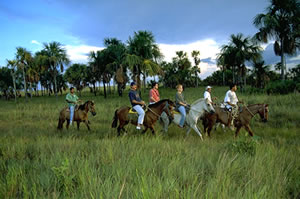 waterways
in a canoe; or perhaps viewing a plethora of exotic wildlife in
unforgettable natural habitats. Los Llanos offers all of this
in a 300,000 km2 (116,000 sq. miles) region where the hectic city
life is a remote dream surrounded by amazing views as far as the
eye can see.
waterways
in a canoe; or perhaps viewing a plethora of exotic wildlife in
unforgettable natural habitats. Los Llanos offers all of this
in a 300,000 km2 (116,000 sq. miles) region where the hectic city
life is a remote dream surrounded by amazing views as far as the
eye can see.
Los
Llanos are not desolate, by any means. The plains offer three
primary habitats: woodlands, savannahs and the water bodies, including
rivers, marshes and lagoons. The forests contain macaws, curassows,
caciques, howler monkeys and even ocelot, while the grasslands
are home to a large 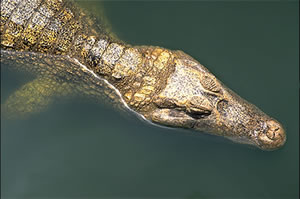 variety
of seed-eating birds, raptors, the giant anteater, deer, jaguarundi
and an endemic armadillo species. But with well over 350 species,
the wetlands are truly a birdwatcher’s dream, especially
in the dry season, when wildlife gather at the few watering holes
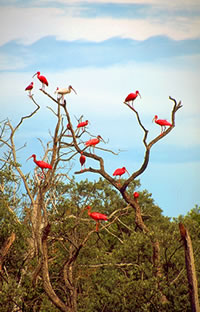
available. Here it is not uncommon to safely see capybara, caracara,
spectacled cayman, anaconda, scarlet ibis and jabiru in the same
lagoon, with ducks, herons, kingfishers, hoatzin and osprey nearby.
You might even spot the abundant river dolphin feeding on piranha
or crustaceans in the rivers! Talk about a South American safari!
variety
of seed-eating birds, raptors, the giant anteater, deer, jaguarundi
and an endemic armadillo species. But with well over 350 species,
the wetlands are truly a birdwatcher’s dream, especially
in the dry season, when wildlife gather at the few watering holes
available. Here it is not uncommon to safely see capybara, caracara,
spectacled cayman, anaconda, scarlet ibis and jabiru in the same
lagoon, with ducks, herons, kingfishers, hoatzin and osprey nearby.
You might even spot the abundant river dolphin feeding on piranha
or crustaceans in the rivers! Talk about a South American safari!
Would you like to book
your own
South American Safari in Los Llanos? Angel-Eco Tours
offers 3-day trips to the Venezuelan plains with accommodations
in a local hato, a safari drive and boat tour to view hundreds
of various wildlife species, and after-dinner helpings of local "joropo" folk music.